Wednesday, September 26, 2012

Descanso

That's Spanish for 'rest,' which is the term used to describe a day off -- a day of rest.  Tuesday is my day of rest, and yesterday I woke up and just HAD to have an American Style breakfast -- pancakes and bacon.  So I walked to the IHOP, which is about a half-dozen blocks from the house.  It put me in such a good mood -- must have been the sugar rush from all that syrup. '

Anyway, I usually go shopping for my day off, but decided to get a real rest and do something different.  Mexico City is a great place for anyone who likes museums (someone like me, for instance) because there are more museums here than in any other city in the world.  I decided that I would go to the Museum of Modern Art, which is within walking distance of the house.  (A long walk, but a walk nonetheless). 

As luck would have it, the permanent exhibits were closed.  Either there was no explanation, or I didn't understand the explanation that was given to me by the person at the main desk.  In any event, I was prepared to enjoy a relaxing day at a museum, and I was not about to be deterred.  So I decided to go to the Museo Nacional de San Carlos, which was a bus ride away, near the center of the city.

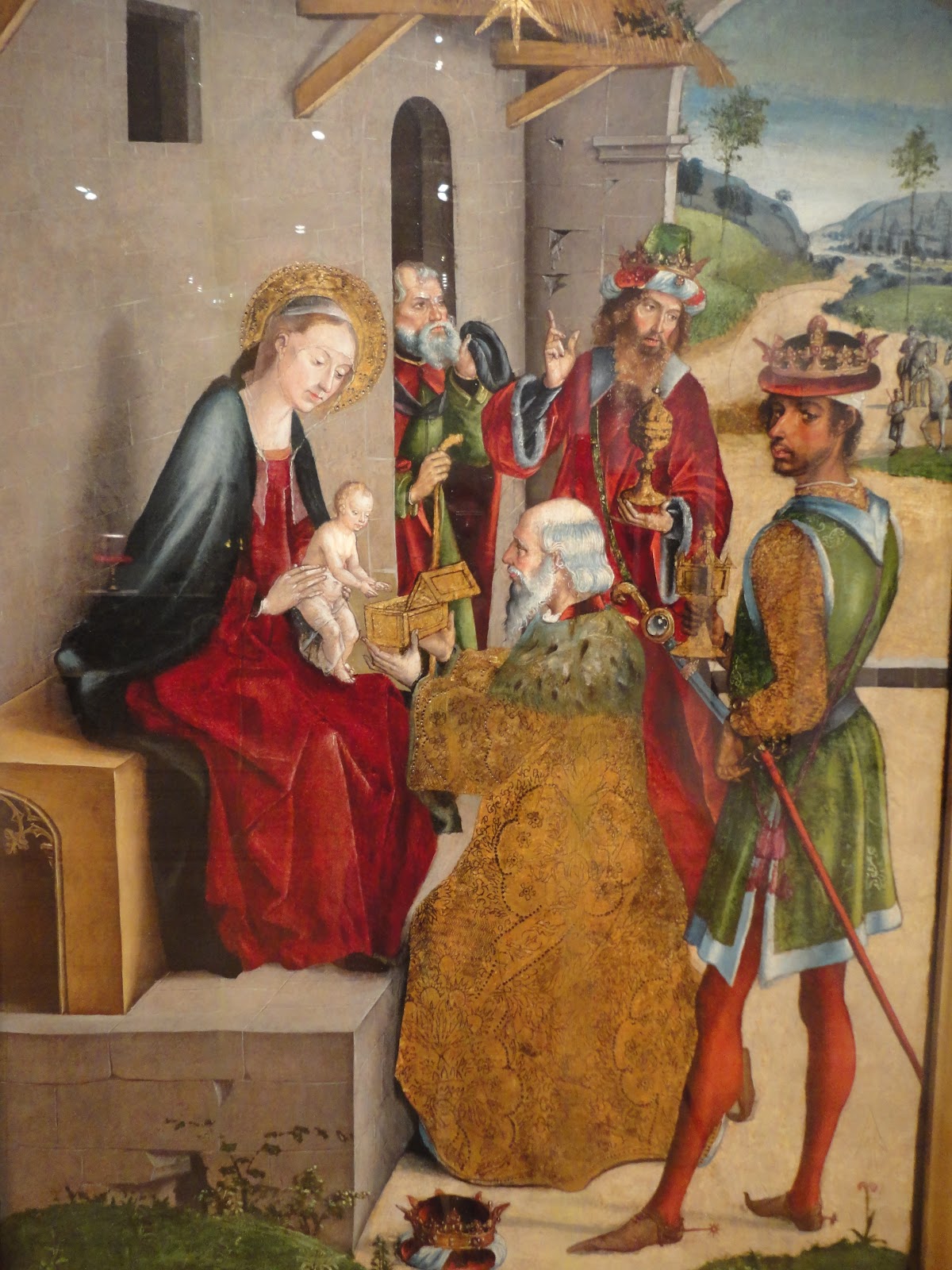
It is housed in a seventeenth century hacienda, with an open-air sort of courtyard.  Like many of the large homes of that era, it was eventually abandoned, and used for another purpose.  This grand home was used at one point as a tobacco factory (the neighborhood to this day is known as "tablaclera.") As luck would have it, about half of the permanent exhibit was closed.  Only the Medieval, Renaissance, and Baroque exhibits were open.  However, it was enough. Here are a couple of examples of the kind of things I was able to see.
 
This is a Renaissance Altar frontal, for example, and below is a Madonna and Child:
There was also a marvelous Spanish baroque oil painting of Christ washing the feet of his disciples, which was my favorite in the whole museum.  As I looked at it, I thought to myself that I might be able to refer to some of the imagery of that painting in a sermon some day! 
 
One of the weird aspects of the museum was that the temporary exhibit (of an artist whose name escapes me) was actually displayed side by side with the permanent exhibit, as a kind of commentary on the works displayed from each era.  Here is the collage displayed in the room with Spanish Baroque art. 
 
Elaborate, overblown, full of detail -- I guess in a way it reflects the Baroque ideals...
 
After the Museo San Carlos, I walked a few blocks to the Church of San Fernando, which also is home to one of Mexico's important cemeteries.  Although my grasp of Mexican history is weak enough that I couldn't and didn't identify many of the heroes who were buried there, it was still an impressive and interesting monument.
 
 The Church dates from the 17th century -- or was it the 18th...?  At any way, it boasts another extraordinary gilded altar frontal and an elaborate carved exterior.
 

Tuesday, September 18, 2012

Así lo haremos

In nearly 25 years of priesthood I have had the privilege and honor of experiencing so much.  And being in a new country, in a new culture, means that some experiences have become totally new to me.  For example, although I have attended many ordinations, been honored to be a presenter for several persons, and even had the blessing of preaching at an ordination, I've never been to an ordination in Mexico.  Before this weekend, that is, when Christ Church was host to the ordination of a (transitional) deacon at noon on Saturday.

As typically happens for an ordination, clergy from around the diocese gathered to offer their prayers, presence, and support.  Here we are, gathered before the service. 


The ordinand, Ricardo, used to worship here, and also did his field work at Christ Church, so he is known to many of the parishioners. 
 
Like most Anglican/Episcopal services, this one was filled with pomp and pageantry:


The Bishop and his Chaplain
Deacon Jorge, acolyte Adolfo, and priest associate Padre Guillermo in the patio before the service , and two more acolytes, Juan and Hiram, who are currently students at Seminario San Andrés.
 
It was, of course, a particular honor to be asked to be a presenter for Ricardo's ordination, but it was especially moving to experience a familiar service in another language.  The nuances of meaning are always a little different in every translation, and I found that I was especially touched by answering the question which in English is - Will you support him in his ministry? The answer in Spanish is Así lo haremos, which is somewhat stronger than the English-language "We will," but more literally translates to "Thus will we do," which I believe is stronger, since it contains the VERB 'haremos' -- We will do. 
 
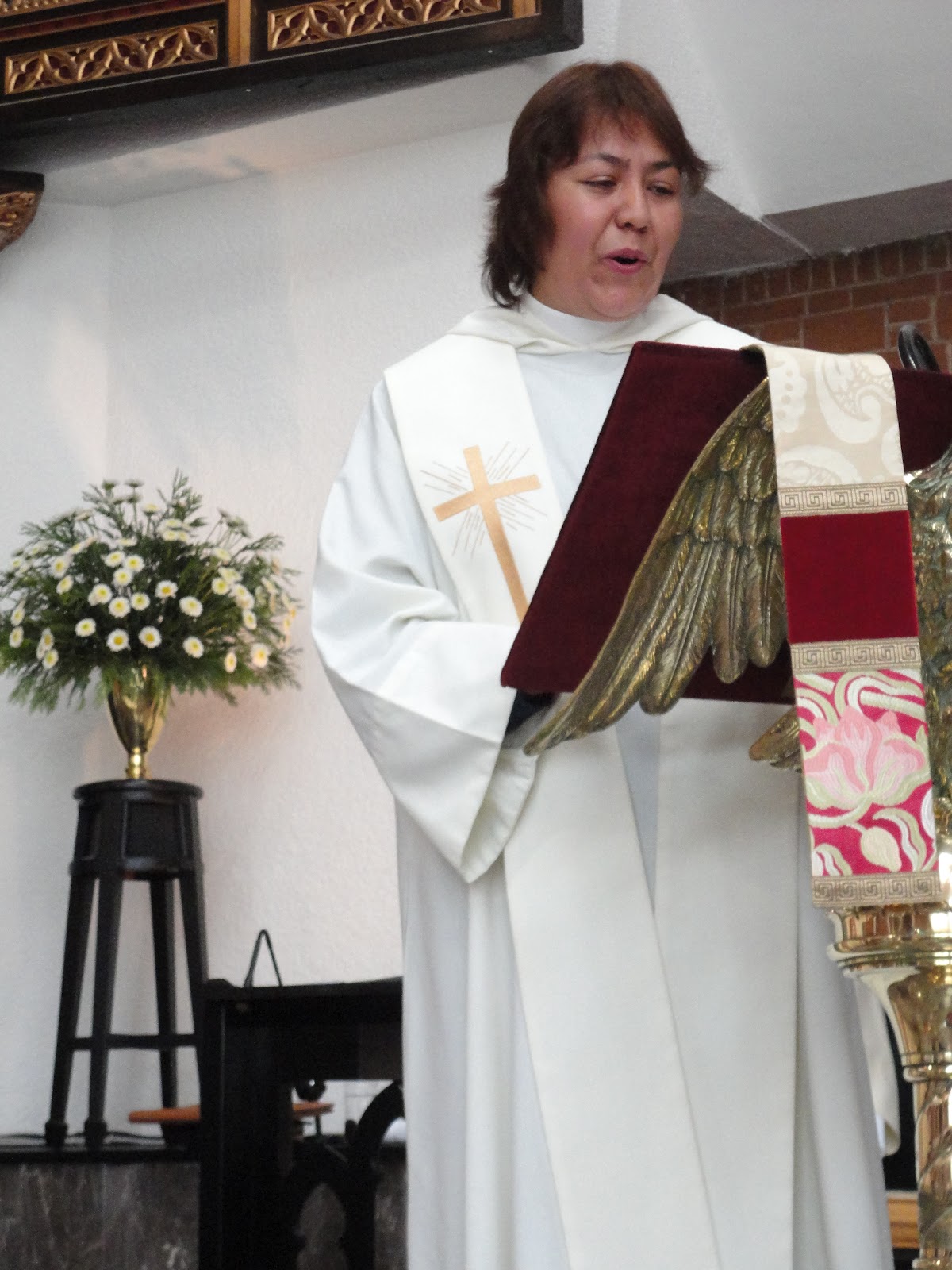
Lest all of the above photos lead you to conclude that only men are ordained in the Anglican Province of Mexico, this next photo shows La Madre Sally Sue who was minister of ceremonies and also preached the sermon.
 
 
The newly ordained, vested in dalmatic, receives his Bible, and sets the table for communion.
Pomp and pageantry -- we are Anglicans, of course.  But the ordaination wasn't the only bit of pageantry that day.  You see, it was also the Independence Day weekend, so the parish hall was festively decorated, and  many parishioners were dressed in festive garb -- not red white and blue, but red white and GREEN, which are the colors of the Mexican flag. 
 Those who had not come in the traditional colors of the Mexican flag were invited (encouraged?) (coerced??) into donning the colors. 


Monday, August 20, 2012

The Celebration of a New Ministry

Two days ago, on Saturday August 18, I was instituted as the 25th Rector of Christ Church in Mexico City.  It was a beautiful, inspiring, and deeply moving occasion. 

The Bishop of the Diocese of Mexico, the Most Rev. Carlos Touché Porter, who is also the Primate of the Anglican Church of Mexico, was the presider. 

The Rev. Tamara Newell, left, the first woman ordained in the Anglican Church in Mexico was the preacher.  She did a splendid job, using the story of Moses and the seventy elders to talk about the work of God's Spirit in the community.  To her left is my good friend and colleague, The Rev. Guillermo Salinas, who is Priest Associate at Christ Church and is also a medical doctor. 

There were a number of other clergy present from the Anglican Church of Mexico.  Also in attendance were ecumenical clergy, including the proto-presbyter of the Greek Orthodox Cathedral in Mexico City, seen here at the far left, and clergy of the Lutheran Church (also representing the Latin American Council of Churches), the Salvation Army, and the Mormon Church. 


The heart of the service, however, is the presentation of the symbols of office to the new rector.  Here, two of my colleagues, the Rev. Andrés Solis of the Cathedral of San José de Gracia and The Rev. Xavier Ocampo, Vicar of Santa Cruz, present me with the Canons of the Anglican Church of Mexico.  
I was also officially presented with the keys to the Church by the Wardens.
Presentations of the bread and wine, the Bible, the Prayerbook, and oil for anointing also took place.  Since part of the congregation is Spanish-speaking, and part is English-speaking, representatives of each group participated in their own native language. 

At the end of the presentations, also called the Service of Induction, the Bishop invites the congregation to "Greet your New Rector."  Susan was also introduced at this time.


Afterwards, there was a lavish reception, with, naturally a sheet cake. 


Sunday, July 1, 2012

Another Country

I vow to thee, my country—all earthly things above—
Entire and whole and perfect, the service of my love;
The love that asks no question, the love that stands the test,
That lays upon the altar the dearest and the best;
The love that never falters, the love that pays the price,
The love that makes undaunted the final sacrifice.


And there’s another country, I’ve heard of long ago—
Most dear to them that love her, most great to them that know;
We may not count her armies, we may not see her King;
Her fortress is a faithful heart, her pride is suffering;
And soul by soul and silently her shining bounds increase,
And her ways are ways of gentleness, and all her paths are peace.


The lyrics to the hymn above were written by Cecil Spring-Rice, born in England. who served in his country's foreign service in Russia, Persia, Sweden, and the US.  He died in Canada in 1918.  The lyrics are set to the tune Thaxted, a lovely but rather difficult to sing melody from Gustav Holst.  Nonetheless, this hymn contains what is is probably the best and most theologically accurate description of the nature of Christian patriotism: our wholehearted love of our own country is superceded by our love for and loyalty to another country, the heavenly country where we hold our eternal citizenship.

We sang the above hymn this morning in church, and I found myself profoundly as I looked around at the congregation, and thought about the nature of  'country' and what it means to the members of this parish, who gather together from the US, the UK, Canada, Nigeria, Germany, the Netherlands and, of course, Mexico.  As challenging as the melody is to sing, the members of Christ Church lifted their voices with gusto -- I think they understand deeply and intrisically, perhaps better than any group of people I've ever known, the complex nature of patriotism.  Many either have grown up in one country but live now in another, are bi- or tri- lingual, or are members of the expatriate community and identify strongly with both Mexico and another nation. They know better than others what it means to be a citizen of an earthly country and a citizen of a heavenly country.

Today is a national day here -- it is election day in Mexico -- some members came to church with their thumbs colored by the indelible ink that is used to identify those who have voted (this, evidently, is meant to prevent electoral fraud.)  It is also Canada Day, and, of course, Independence Day weekend in the country of my birth and citizenship, the US.  At the close of the service, then, after vowing our love to our home country and our heavenly country, we sang the Star-Spangled Banner -- led by our choir which is comprised almost entirely of Mexican citizens -- and then O Canada. 

God, grant that I might be a good citizen. 

Saturday, June 23, 2012

Hail and Farewell at St. Andrew's

St. Andrew's, or San Andres,  is located in the southern part of Mexico City.  On the one campus is located St. Andrew's Seminary for the Anglican Church of Mexico, the Offices of the Diocese of Mexico, the Offices of the Anglican Church of Mexico, a retreat and conference center, and the residence of the Bishop. 


The Seminary chapel is a modern building, a church-in-the-round of the style that was popular about 30 or so years ago when it was built. 

Yesterday the Clericus, which is the monthly meeting of Anglican clergy of the diocese, met there 
for our regularly scheduled gathering.  It was no ordinary gathering, but the farewell to a beloved colleague, the Rector of the other English-speaking parish in the Diocese, whose church is about 4 hours from Mexico City in the town of San Miguel de Allende.  Since it was the first time I had met him, it was a 'hail and farewell' as they say.  Although there are a number of English-speaking parishes scattered throughout Mexico, with his departure and the retirement of teh rector of St. Michael's in Cuernavaca, I remain the only Rector of an English-speaking parish remaining in this part of the country.  Fortunately, I am not the only English speaking Anglican priest -- a number of my colleagues speak fair to excellent English, and one has even studied in the UK. 

I loved worshipping in this modern building -- the altar is in the very center of the round building, set up on a dais, so that when communion is served, the whole congregation gathers in a circle around the altar to receive the sacrament.  It felt like being a part of the family at the family table.  Since the building is constructed of stone and tile, the acoustics are marvelous, and even though we were only about 25 in number, the building resounded when we sang.  Although the interior is relatively plain, it did not have the feeling of being cold or severe that so many modern church buildings have. 


We gathered for Eucharist to begin the day.


At the conclusion of the service, those celebrating anniversaries of ordination were called to the front of the chapel for a prayer, and a gift was presented to the parting priest.
I often have to pause to remember the still rather startling reality that I am now a priest of the Anglican Church of Mexico, rather than of the Episcopal Church in the US.  Inspiring events like this one at St. Andrew's remind me of that reality, and the more important reality that I am not alone in this work, but joined by a cohort of devoted and talented clergy. 

Monday, June 18, 2012

MORE Diamond Jubilee

As as said, the celebration goes on ... or rather, went on. 

Saturday of the Jubilee weekend, I was invited to the celebration of the Queen's Diamond Jubilee hsoted by the British Society of Mexico City, which was held at the Club Industrial -- a private club for the business elite of the Federal District.  There were about 150 people present. 

The guest of honor was H.E. Judith MacGregor, the British Ambassador to Mexico.  Here she is being escorted into the dining room by a bagpiper of St. Patrick's Battalion.  Beside here is her husband (wearing clan MacGregor tartan, or course.)

Of course the Rector of the Anglican Parish gave the grace (that would be me), first saying the official jubilee prayer.  The Ambassador led the assembled group in two toasts -- one for the queen and the other for Mexico.  Somehow I found it very moving that folks recognized both their native land and their adopted homeland, joining in saying Viva Mexico!
I felt very proud that Christ Church's choir concluded the event with a presentation that included two of Handel's Coronation Anthems, plus traditional and folk music of all of the British Isles.  Selections included The Londonderry Air (popularly known as O Danny Boy) and Rule Brittania!   I was moved to tears when they sang A Celtic Blessing.

Lunch was -- of all things -- quail!  I guess the menu was chosen to be suggestive of hunting game out on the moors or something. 


Truly, I am grateful for so many opportunities to meet so many fascinating people.  It is a gift. 

Tuesday, June 5, 2012

Diamond Jubilee

In my nearly 25 years as a priest of the Church, I have done many different tasks, worshipped in a variety of ways, and joined in singing many different types of music.  But Sunday was a real first for me.  First time I prayed for the Queen of England.  First time I sang God Save the Queen.  First time I read a reminder for Sunday services that bore the instructions: "Ladies, please don your hats."  They did.  And I did.  (not don a hat, but I sang God Save the Queen and prayed for Her Majesty.  In this international and multi-cultural setting, particularly with a (relatively) large number of British worshipping with us, it made sense to acknowledge the extraordinary 60 years of the world's longest reigning monarch.  Especially since she is an Anglican lay woman who has been involved in the appointment of bishops, and been present to inaugurate  innumerable church-affiliated schools and hospitals over the years. 
Since it was a special Sunday, we had not only our usual cadre of acolytes, one of the faithful took the role of verger to lead the processeion in front of the crucifer.  He looked very dapper, and, for some reason, I thought, very British.  The choir sang the Coronation Anthem  from Handel's Oratorio Zadok the Priest. And they led the singing of the National Anthem of the United Kingdom (God Save the Queen). 
After church at coffee hour there was sparkling wine and cake filled with marzipan and frosted with (what else?) royal icing.  It was a very festive day, and not only our own members from the UK and the commonwealth were present, but also a few special guests from the diplomatic community, including the Jamaican Ambassador, and representatives from the British and the Australian embassies. 


Here is a member of the parish with Justin MacKenzie, a representative of the British Ambassador. 
And here is another parishioner with H.E. Delrose Montague, Ambassador from Jamaica. 


As it seems to be in England, the celebration goes on and on...The British Community here in Mexico City will be having several events to mark this momentous occasion.  There are at least two more this week.  Vivat Regina!