I vow to thee, my country—all earthly things above—
Entire and whole and perfect, the service of my love;
The love that asks no question, the love that stands the test,
That lays upon the altar the dearest and the best;
The love that never falters, the love that pays the price,
The love that makes undaunted the final sacrifice.
And there’s another country, I’ve heard of long ago—
Most dear to them that love her, most great to them that know;
We may not count her armies, we may not see her King;
Her fortress is a faithful heart, her pride is suffering;
And soul by soul and silently her shining bounds increase,
And her ways are ways of gentleness, and all her paths are peace.
The lyrics to the hymn above were written by Cecil Spring-Rice, born in England. who served in his country's foreign service in Russia, Persia, Sweden, and the US. He died in Canada in 1918. The lyrics are set to the tune Thaxted, a lovely but rather difficult to sing melody from Gustav Holst. Nonetheless, this hymn contains what is is probably the best and most theologically accurate description of the nature of Christian patriotism: our wholehearted love of our own country is superceded by our love for and loyalty to another country, the heavenly country where we hold our eternal citizenship.
We sang the above hymn this morning in church, and I found myself profoundly as I looked around at the congregation, and thought about the nature of 'country' and what it means to the members of this parish, who gather together from the US, the UK, Canada, Nigeria, Germany, the Netherlands and, of course, Mexico. As challenging as the melody is to sing, the members of Christ Church lifted their voices with gusto -- I think they understand deeply and intrisically, perhaps better than any group of people I've ever known, the complex nature of patriotism. Many either have grown up in one country but live now in another, are bi- or tri- lingual, or are members of the expatriate community and identify strongly with both Mexico and another nation. They know better than others what it means to be a citizen of an earthly country and a citizen of a heavenly country.
Today is a national day here -- it is election day in Mexico -- some members came to church with their thumbs colored by the indelible ink that is used to identify those who have voted (this, evidently, is meant to prevent electoral fraud.) It is also Canada Day, and, of course, Independence Day weekend in the country of my birth and citizenship, the US. At the close of the service, then, after vowing our love to our home country and our heavenly country, we sang the Star-Spangled Banner -- led by our choir which is comprised almost entirely of Mexican citizens -- and then O Canada.
God, grant that I might be a good citizen.
Sunday, July 1, 2012

Saturday, June 23, 2012
Hail and Farewell at St. Andrew's
St. Andrew's, or San Andres, is located in the southern part of Mexico City. On the one campus is located St. Andrew's Seminary for the Anglican Church of Mexico, the Offices of the Diocese of Mexico, the Offices of the Anglican Church of Mexico, a retreat and conference center, and the residence of the Bishop.


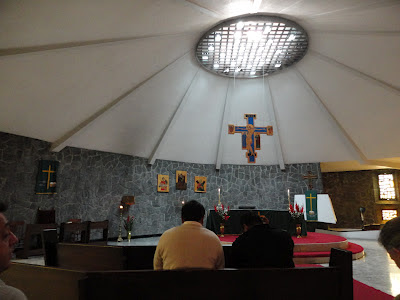
The Seminary chapel is a modern building, a church-in-the-round of the style that was popular about 30 or so years ago when it was built.

I loved worshipping in this modern building -- the altar is in the very center of the round building, set up on a dais, so that when communion is served, the whole congregation gathers in a circle around the altar to receive the sacrament. It felt like being a part of the family at the family table. Since the building is constructed of stone and tile, the acoustics are marvelous, and even though we were only about 25 in number, the building resounded when we sang. Although the interior is relatively plain, it did not have the feeling of being cold or severe that so many modern church buildings have.
We gathered for Eucharist to begin the day.


The Seminary chapel is a modern building, a church-in-the-round of the style that was popular about 30 or so years ago when it was built.

Yesterday the Clericus, which is the monthly meeting of Anglican clergy of the diocese, met there
for our regularly scheduled gathering. It was no ordinary gathering, but the farewell to a beloved colleague, the Rector of the other English-speaking parish in the Diocese, whose church is about 4 hours from Mexico City in the town of San Miguel de Allende. Since it was the first time I had met him, it was a 'hail and farewell' as they say. Although there are a number of English-speaking parishes scattered throughout Mexico, with his departure and the retirement of teh rector of St. Michael's in Cuernavaca, I remain the only Rector of an English-speaking parish remaining in this part of the country. Fortunately, I am not the only English speaking Anglican priest -- a number of my colleagues speak fair to excellent English, and one has even studied in the UK. I loved worshipping in this modern building -- the altar is in the very center of the round building, set up on a dais, so that when communion is served, the whole congregation gathers in a circle around the altar to receive the sacrament. It felt like being a part of the family at the family table. Since the building is constructed of stone and tile, the acoustics are marvelous, and even though we were only about 25 in number, the building resounded when we sang. Although the interior is relatively plain, it did not have the feeling of being cold or severe that so many modern church buildings have.

We gathered for Eucharist to begin the day.

At the conclusion of the service, those celebrating anniversaries of ordination were called to the front of the chapel for a prayer, and a gift was presented to the parting priest.

I often have to pause to remember the still rather startling reality that I am now a priest of the Anglican Church of Mexico, rather than of the Episcopal Church in the US. Inspiring events like this one at St. Andrew's remind me of that reality, and the more important reality that I am not alone in this work, but joined by a cohort of devoted and talented clergy.
Monday, June 18, 2012
MORE Diamond Jubilee
.jpg)
Saturday of the Jubilee weekend, I was invited to the celebration of the Queen's Diamond Jubilee hsoted by the British Society of Mexico City, which was held at the Club Industrial -- a private club for the business elite of the Federal District. There were about 150 people present.

The guest of honor was H.E. Judith MacGregor, the British Ambassador to Mexico. Here she is being escorted into the dining room by a bagpiper of St. Patrick's Battalion. Beside here is her husband (wearing clan MacGregor tartan, or course.)


Lunch was -- of all things -- quail! I guess the menu was chosen to be suggestive of hunting game out on the moors or something.


Truly, I am grateful for so many opportunities to meet so many fascinating people. It is a gift.
Tuesday, June 5, 2012
Diamond Jubilee
In my nearly 25 years as a priest of the Church, I have done many different tasks, worshipped in a variety of ways, and joined in singing many different types of music. But Sunday was a real first for me. First time I prayed for the Queen of England. First time I sang God Save the Queen. First time I read a reminder for Sunday services that bore the instructions: "Ladies, please don your hats." They did. And I did. (not don a hat, but I sang God Save the Queen and prayed for Her Majesty. In this international and multi-cultural setting, particularly with a (relatively) large number of British worshipping with us, it made sense to acknowledge the extraordinary 60 years of the world's longest reigning monarch. Especially since she is an Anglican lay woman who has been involved in the appointment of bishops, and been present to inaugurate innumerable church-affiliated schools and hospitals over the years.

 Since it was a special Sunday, we had not only our usual cadre of acolytes, one of the faithful took the role of verger to lead the processeion in front of the crucifer. He looked very dapper, and, for some reason, I thought, very British. The choir sang the Coronation Anthem from Handel's Oratorio Zadok the Priest. And they led the singing of the National Anthem of the United Kingdom (God Save the Queen).


 Here is a member of the parish with Justin MacKenzie, a representative of the British Ambassador.


 Since it was a special Sunday, we had not only our usual cadre of acolytes, one of the faithful took the role of verger to lead the processeion in front of the crucifer. He looked very dapper, and, for some reason, I thought, very British. The choir sang the Coronation Anthem from Handel's Oratorio Zadok the Priest. And they led the singing of the National Anthem of the United Kingdom (God Save the Queen).
After church at coffee hour there was sparkling wine and cake filled with marzipan and frosted with (what else?) royal icing. It was a very festive day, and not only our own members from the UK and the commonwealth were present, but also a few special guests from the diplomatic community, including the Jamaican Ambassador, and representatives from the British and the Australian embassies.


 Here is a member of the parish with Justin MacKenzie, a representative of the British Ambassador.
And here is another parishioner with H.E. Delrose Montague, Ambassador from Jamaica.

As it seems to be in England, the celebration goes on and on...The British Community here in Mexico City will be having several events to mark this momentous occasion. There are at least two more this week. Vivat Regina!
Wednesday, May 30, 2012
Memorial Day in Mexico City
Over the years I've been invited to participate in a number of Memorial Day observances -- to say the invocation in the park or the benediction at the cemetery. But in all the years I've been a priest i have never (I'm ashamed to say) willingly chosen to attend a Memorial Day Observance. Being here in Mexico City, far from the traditions of home, family, and culture, I feel differently. When I received an email from a local charity with the reminder of the Memorial Day observance at the American Military Cemetery, something strange happened to me. I wanted to go. Something about a slice of home, nostalgia, whatever... I just had to take time to attend. I couldn't let Memorial Day be just another ordinary workday. Plus I felt the need to acknowledge my connection with the American expatriate community, especially since I knew I would be making a special connection with the British expatriate community over the weekend of the Queen's Diamond Jubilee.
The Cemetery is in a rather obscure commercial neighborhood not so far outside of the center of the city. I say it's obscure, because when I caught a taxi from the Metro station nearest to the cemetery, the driver told me there was no American Cemetery nearby. (Mexican cab drivers are NOT like cab drivers in NYC who know the city. In fact, some of them are downright clueless -- they would have to be for ME to be giving them directions!) Anyway, I arrived at the ceremony about 20 minutes late, in a foul mood, which immediately lifted when I looked around to see the gorgeously beautiful setting. It was like a small but lush tropical garden.


There were approximately 200 people at the Memorial Day Ceremony -- this included representatives from the British Foreign Legion and the Mexican Veterans Association as well -- a point which I actually found very moving. I want to find out more about how the Mexican
Air Force assisted the US war effort during World War II, as some of the elderly Mexican veterans present were involved in that.
Although the ceremony was a very typical Memorial day observance with all of the usual ritual -- of course at the same time it was UNtypical, because of the location.


ABMC -- "Ameican Battle Monuments Commission" -- refers to some kind of US Federal or Military Agency that administers this property. I think this cemetery might have actually been founded as a place to bury the war dead from the Mexican-American War of 1848 (still a bit of a sore point here -- after all Mexico lost about one-third of its territoy to the US in that conflict).
There were approximately 200 people at the Memorial Day Ceremony -- this included representatives from the British Foreign Legion and the Mexican Veterans Association as well -- a point which I actually found very moving. I want to find out more about how the Mexican
Air Force assisted the US war effort during World War II, as some of the elderly Mexican veterans present were involved in that.


The address was given by the US Embassador to Mexico, H.E. Earl Anthony Wayne, who focused on the role that cooperation between nations plays in securing a free and democratic world. It was quite well done, and hearing it made me even more glad I had made the effort to attend.
I was also glad that I ran into some members of Christ Church -- some embassy people, some not -- who were present for the day's event.
Tuesday, May 29, 2012
Sunday in the Park...with Frank
Sunday after Church I was tired...but decided that since it was a gorgeous summer day I couldn't stay inside and nap. So I decided to explore a part of the city I had never seen before. Condesa, which is Spanish for "Countess" is a neighborhood between Lomas de Chapultepec where I live and the historic center downtown.
The older section of the neighborhood is centered around a four- or five- block long oval shaped park that began its life as a horse racing track. The exterior of the track was preserved and is currently a city Avenue, the interior of the track is a charming tropical park.


The park was what I think of as a typical urban park -- full of families with small children, skateboarders, bicyclists, vendors selling food, clothing, jewelry, balloons, and toys. There were also stands where children could paint and decorate ceramic or wooden plaques in the shape of popular cartoon characters. And there were SO MANY dogs -- most were small like chihuahuas and pekinese, and not all were on leashes. And of course there were musicians, too, and street preachers.


Since the neighborhood was developed mostly in the 1920's, most of the buildings were designed in the architectural style popular at the time -- art deco. Eventually the area fell into disuse and disrepair, and so it was neglected and never redeveloped. The happy result, of this is that many of the original buildings and monuments have remained. Now that Condesa is once again becoming a fashionable and desirable neighborhood, the art deco style is being preserved. Mexicans, it seems to me, have a real appreciation for art and architecture.

 This clock tower is a particularly good example of art deco design. Here is a view of one of the neighborhood streets, with more art deco design.

The older section of the neighborhood is centered around a four- or five- block long oval shaped park that began its life as a horse racing track. The exterior of the track was preserved and is currently a city Avenue, the interior of the track is a charming tropical park.


The park was what I think of as a typical urban park -- full of families with small children, skateboarders, bicyclists, vendors selling food, clothing, jewelry, balloons, and toys. There were also stands where children could paint and decorate ceramic or wooden plaques in the shape of popular cartoon characters. And there were SO MANY dogs -- most were small like chihuahuas and pekinese, and not all were on leashes. And of course there were musicians, too, and street preachers.


Since the neighborhood was developed mostly in the 1920's, most of the buildings were designed in the architectural style popular at the time -- art deco. Eventually the area fell into disuse and disrepair, and so it was neglected and never redeveloped. The happy result, of this is that many of the original buildings and monuments have remained. Now that Condesa is once again becoming a fashionable and desirable neighborhood, the art deco style is being preserved. Mexicans, it seems to me, have a real appreciation for art and architecture.


Sunday, May 27, 2012
Confirmation at Christ Church
Today was Pentecost Sunday, the Feast of the Holy Spirit, and the birthday of the Church, the fiftieth and last day of Easter Season. You may have known all (or at least some) of that. I didn't know, and the bishop explained to me, that since Pentecost is the day when the Church was inaugurated, it is also the feast of title (i.e. the patronal feast) of any church named "Christ Church," since every Church carries on Christ's work through their ministry. Anyway, that's why this parish has always hosted the bishop for confirmations on this particular Sunday.

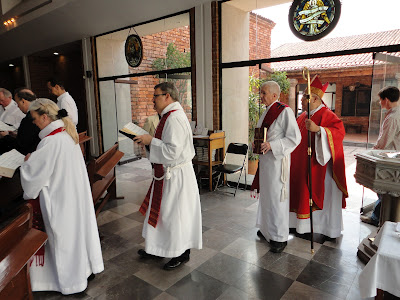
Of course, we sang Hail Thee! Festival Day as the opening hymn. How could we not, after the bishop said it was his favorite hymn? I do think the Easter lyrics are superior to the Pentecost lyrics, but still, it is a stirring mix of word and music.
The choir was in more than full force, and sang the Schubert Mass in G.

There was one confirmand, a teenager, and it turns out that the bishop remembered him as a small boy from the time before he was bishop. He was rector of the family's parish in the south of the city.
Here is Eduardo, the confirmand, with Mother Susan, the priest who prepared him and presented him for confirmation.

One of the traditions at Christ Church is that since Pentecost is the birthday of the Church, we have cake at coffee hour after the service. Actually, we have TWELVE cakes -- one for each month of the year. I'm not sure if you're supposed to eat the cake representing your birth month only -- November was a vanilla cake with penuche frosting with walnuts. But I had to try some of December's Hazelnut torte, which was scrumptious.
All in all, it was an exciting and beautiful day, and a wonderful celebration of the third major feast of the church. And it would have been enough, except...we also had a baptism and a first communion at 12:30 service. This was followed by a Mexican lunch of Pozole (a thick soup of chicken and hominy, with multiple garnishes like diced radish, onion, avocado, minced jalapeno, chili powder, oregano, and lettuce. I would never have thought to put lettuce in my soup, but it was actually quite good. The other traditional "accompaniment" that is to be taken with pozole is mezcal, which is a fermented beverage that is distilled into tequila. Every person at the reception following the 12:30 service received as a party favor a ceramic cup, shaped like a tiny jug, that held about a shot glass full of mezcal. Which is all you needed, since it is STRONG -- not only in alcoholic content, but also in flavor. It is very earthy, and burns a bit, going down. After you take a sip of mezcal you suck on a lime then take a spoonful of the pozole. Or some I was told.


Of course, we sang Hail Thee! Festival Day as the opening hymn. How could we not, after the bishop said it was his favorite hymn? I do think the Easter lyrics are superior to the Pentecost lyrics, but still, it is a stirring mix of word and music.
The choir was in more than full force, and sang the Schubert Mass in G.

There was one confirmand, a teenager, and it turns out that the bishop remembered him as a small boy from the time before he was bishop. He was rector of the family's parish in the south of the city.
Here is Eduardo, the confirmand, with Mother Susan, the priest who prepared him and presented him for confirmation.

One of the traditions at Christ Church is that since Pentecost is the birthday of the Church, we have cake at coffee hour after the service. Actually, we have TWELVE cakes -- one for each month of the year. I'm not sure if you're supposed to eat the cake representing your birth month only -- November was a vanilla cake with penuche frosting with walnuts. But I had to try some of December's Hazelnut torte, which was scrumptious.
All in all, it was an exciting and beautiful day, and a wonderful celebration of the third major feast of the church. And it would have been enough, except...we also had a baptism and a first communion at 12:30 service. This was followed by a Mexican lunch of Pozole (a thick soup of chicken and hominy, with multiple garnishes like diced radish, onion, avocado, minced jalapeno, chili powder, oregano, and lettuce. I would never have thought to put lettuce in my soup, but it was actually quite good. The other traditional "accompaniment" that is to be taken with pozole is mezcal, which is a fermented beverage that is distilled into tequila. Every person at the reception following the 12:30 service received as a party favor a ceramic cup, shaped like a tiny jug, that held about a shot glass full of mezcal. Which is all you needed, since it is STRONG -- not only in alcoholic content, but also in flavor. It is very earthy, and burns a bit, going down. After you take a sip of mezcal you suck on a lime then take a spoonful of the pozole. Or some I was told.


Subscribe to:
Posts (Atom)