Sunday, May 27, 2012

Confirmation at Christ Church

Today was Pentecost Sunday, the Feast of the Holy Spirit, and the birthday of the Church, the fiftieth and last day of Easter Season.  You may have known all  (or at least some) of that.  I didn't know, and the bishop explained to me, that since Pentecost is the day when the Church was inaugurated, it is also the feast of title (i.e. the patronal feast) of any church named "Christ Church," since every Church carries on Christ's work through their ministry.  Anyway, that's why this parish has always hosted the bishop for confirmations on this particular Sunday. 


Of course, we sang Hail Thee! Festival Day as the opening hymn.  How could we not, after the bishop said it was his favorite hymn?  I do think the Easter lyrics are superior to the Pentecost lyrics, but still, it is  a stirring mix of word and music. 


The choir was in more than full force, and sang the Schubert Mass in G.


There was one confirmand, a teenager, and it turns out that the bishop remembered him as a small boy from the time before he was bishop.  He was rector of the family's parish in the south of the city.
Here is Eduardo, the confirmand, with Mother Susan, the priest who prepared him and presented him for confirmation. 


One of the traditions at Christ Church is that since Pentecost is the birthday of the Church, we have cake at coffee hour after the service.  Actually, we have TWELVE cakes -- one for each month of the year.  I'm not sure if you're supposed to eat the cake representing your birth month only -- November was a vanilla cake with penuche frosting with walnuts.  But I had to try some of December's Hazelnut torte, which was scrumptious. 

All in all, it was an exciting and beautiful day, and a wonderful celebration of the third major feast of the church.  And it would have been enough, except...we also had a baptism and a first communion at 12:30 service.  This was followed by a Mexican lunch of Pozole (a thick soup of chicken and hominy, with multiple garnishes like diced radish, onion, avocado, minced jalapeno, chili powder, oregano, and lettuce.  I would never have thought to put lettuce in my soup, but it was actually quite good.  The other traditional "accompaniment" that is to be taken with pozole is mezcal, which is a fermented beverage that is distilled into tequila. Every person at the reception following the 12:30 service received as a party favor a ceramic cup, shaped like a tiny jug, that held about a shot glass full of mezcal.  Which is all you needed, since it is STRONG -- not only in alcoholic content, but also in flavor.  It is very earthy, and burns a bit, going down.  After you take a sip of mezcal you suck on a lime then take a spoonful of the pozole.  Or some I was told. 

Monday, May 21, 2012

Friendship Fair

A couple of years ago, the leadership of Christ Church realized that they could be doing more to welcome the larger comunity to the church, and especially to attract a younger crowd.  What to do?  They came up with the idea, last year, of inviting the embassies, various social organizations, and commercial enterprises to come on a Satuday and to set up booths.  At the same time, they offered a venue for young musicians to share their talents.  Then, of course, they sold food and drink, and so the Friendship Fair was born. 

Saturday. May 19th,  was the second annual.  It began with a ribbon-cutting ceremony.  and guess who got to cut the ribbon? 


Another first for me here in Mexico City!  They even gave me that nifty bright blue t-shirt that all the workers got to wear.

The opening also included bagpipe music from St. Patrick's Battalion. 


There was a variety of music offered, including by Christ Church choir. 

A couple of different rock bands performed as well. 


The closing band offered a tribute to Pink Floyd.  Who would have known they were so popular in Mexico?  They brought in the largest audience of the day!

Other acts included acrobats, clowns, and a magician. 


Of course, as in so many church events, one of the main attractions was THE FOOD.  And here in Mexico City, to have hot dogs and hamburgers American-style cooked outdoors over a grill is a huge treat.  One of the priest associates made homemade Boston-style baked beans (with bacon and molasses), and others brought coleslaw, and all the other fixings... It was really fun.  The first real American style food I've had since coming here in March. 

A huge success -- it generated good will within the community, got some outsiders to visit us (one couple returned the next day for Sunday worship), and even raised a bit of money for the church. 
All in all, a splendid success. 


Saturday, May 12, 2012

Feast of Sta. Juliana

In an earlier post I wrote about the previous site of Christ Church, which was in downtown Mexico City but later abandoned as the church constructed new facilities at the current site in Lomas de Chapultepec, west of the downtown area in what is a largely (though not exclusively) residential neighborhood.  After the earlier location had been neglected for a number of years, it became the site of what was at first a diocesan, and then a Christ Church social outreach ministry.  It is now known as Santa Juliana de Norwich, or "St. Julian of Norwich," which, by felicitous coincidence is the saint after whom our daughter Julian is named.  Nowadays the ministry at Sta. Juliana consists of a weekly Eucharist, and a soup kitchen that ministers to a small group of 10 -15 faithful souls. 

Since May 8th was the feast day of St. Julian, I had the bright idea of using the day to have a celebration of the ministry of that location.  We kept the weekly service, of course, but I invited the bishop to be the celebrant.  He gladly -- no, enthusiastically -- accepted.  I preached, and Father Xavier, who assists at Sta. Juliana, got his choir to lead the music.  George, the deacon, engaged the bagpipers.  It was a splendid, exciting, beatiful celebration. 

Here I am with my bishop, El Revdmo. Carlos Touche Porter:


And here we are with the members of the choir:


After the celebration at the altar, we celebrated around other tables in the parish hall, where we enjoyed a festive meal.  It seems to me that for many Mexicans, a fesive meal is mole -- which many in the US think of as chicken in chocolate sauce.  Real mole is much different, and, although it usually does include cocoa powder, it also includes many other flavors such as chiles, spices, herbs, and sometimes cinnamon or ground nuts.  There were also tamales, which are mostly served on special occasions because their preparation is so labor intensive.  The basic ingredients are masa (corn flour) mixed with other ingredients to make a thick dough which is then wrapped around seasoned meat or vegetables; then the whole is steamed in corn husks

Hail to the cooks!


In the background of each of the above pictures of the fiesta you can seen another element of the day's celebration -- on the walls of the parish hall there was an art show showcasing works by children of a local school. 


The day closed with two fascinating events: in the first, the children painted -- on large pieces of newsprint or directly on the wall.  As they painted, a bassist played, evidently to inspire the children. 


After a while, there were dancers.  I wasn't quite sure if this was to be another source of inspiration, or its own separate artistic presentation.  Note that these are not ballet or contemporary dancers.  Nor are they liturgical dancers. 

These were belly dancers!!!  (I don't know the term in Spanish, but I do know that this is not an indigenous local art form that cultural anthropologists are struggling to preserve.) 

One last aspect of the day's ministry was the distribution of food baskets -- over one hundred of them! -- given to the needy of the neighborhod.  The food baskets contained staples and non-perishable items and were prepared through the generosity of members of Christ Church, and with the cooperation of the Charity Coalition of Mexico City. 

he feast -- The Fiesta -- of Sta. Juliana. 

Thursday, May 10, 2012

A Tale of Two...Hospitals


A break from writing about my time in Oaxaca (more to come on that topic) and a bit about my real work here as priest and pastor in Mexico City. 

One of the ongoing (and invisible) ministries of Christ Church is the ministry to the Hospital General.  Some readers will remember a soap opera of some years back entitled General Hospital and that is the obvious translation of Hospital General.  But the hospital of the same name in Mexico City is no soap opera.  It’s worse.  Hospital General is in a rather run-down facility in a not terribly safe neighborhood near the center of the city.  It is, in fact, large enough to have a metro stop named after it.

Hospital General is basically the place of last resort for indigent who have no other alternatives, and no other resources.   Father Guillermo, who is Priest Associate and mostly responsible for the ongoing pastoral care of the Spanish language congregation, began about five years ago visiting the Emergency Room of the Hospital General to minister there.  When I went on Monday evening to participate in this ministry, I found a waiting room that was dark, cramped, and crowded.  There may have been a television on the wall, but there were certainly no tables, and no reading material available.   Unlike a typical hospital in the US, the Hospital General has no cafeteria or snack bar.  There was not even a vending machine that I could see.  So those who had brought their family members or friends to the Emergency Room and had to wait while they received treatment would need to leave the hospital compound if they wanted anything to eat or drink.  Unless they had brought it from home themselves.  (Few, of course had.)

So the first aspect of Christ Church’s ministry at the hospital is distributing food to those in the waiting room  Sandwiches had been prepared by LuzMaria and her parents – members of the Spanish-language congregation.  As the sandwiches were distributed to the forty or so people in the waiting room, Father Guillermo and LuzMaria asked if anyone thought that their loved one in the emergency room would like a visit and a prayer.  Fr. Guillermo wrote down the name of each person and the bed where they were located.  Then he, LuzMaria, and I proceeded to the Emergency Room. 

Although I have been a priest for nearly 25 years, I was still unprepared for what I saw in the Emergency Room.  There were about twenty or more people on gurneys in a huge room.  There were curtains between each bed that could have been pulled for privacy, but no one had done so, so all patients—men and women, young and old – were out in the open, exposed to all of the others in the emergency room.  Fr. Guillermo and I did the most basic sacramental and pastoral ministry – we offered prayers, laying-on-of-hands, and anointing, A few were well enough to receive communion.   

The saddest cases – one very elderly woman, shriveled by malnutrition, twisted by arthritis, semi-conscious but suffering from dementia, restrained by being tied to the bed. I don’t know if she really understood who we were or what we were doing.    There was also one very young man, certainly no older than 25 years old.  Although his eyes were open he was utterly unresponsive.  He was breathing by means of a respirator attached to a hole in his throat.  While Fr. Guillermo and I were praying for him, I realized that the monitor above his bed was registering nothing – no pulse, no heartbeat, no respiration, no brain activity.  He was being kept alive by machines.  We read the Prayers at the time of death, (commonly known as “Last Rites.”)

The three of us visited about ten or twelve patients in total.  Before we left, Fr. Guillermo offered a prayer for the doctors and the nurses. Although the conditions in the hospital were more than modest, even rudimentary, by US standards and expectations, I saw no impatience or disrespect from any of the doctors, nurses, or staff towards any of the patients   They seemed to be truly compassionate individuals. 

On our return to the waiting area, Fr. Guillermo he offered a prayer and blessing for all of those who were worried about their family members.  Then various family members came to ask him about their husbands, wives, parents, spouses whom we had just visited.  And I realized that they were asking those questions because the three of us were the ONLY non-medical persons in the entire Emergency Room areas.  There were no visiting hours and so many had not seen their loved one since much earlier in the day when they were admitted, and thus the three of us were the only source of information or point of contact. 

The second hospital was utterly different, and I had the chance to visit it the next day, which was Tuesday.  The ABC Hospital, American British Cowdray Hospital, was formed many years ago through the merger of different hospitals that served the English-speaking expatriate community in Mexico City.  Although it is in a neighborhood similar in socio-economic status to the area where the Hospital General is located, the ABC Hospital is worlds away from the Hospital General. 

In contrast to the Hospital General, the ABC hospital is a private hospital.  It is immaculately well-kept, tightly run, and with up-to-date equipment.   Several of the members of Christ Church serve on the Board of the hospital, help with fund raisers, or volunteer their time as ‘pink ladies.’  To the great credit of The ABC hospital, they run a clinic where residents of the neighborhood where they are located can receive quality health care at low or no cost.

The ABC Hospital is not just an acute care facility, it also contains a number of divisions, including a center for neurosurgery, a children’s hospital, and a cancer treatment center.  Plans are in the works for a medical school.  One of the great surprises to me was that every patient room, no matter whether in medical, surgical, or intensive care units, is a private (single) room but with facilities including a fold-out sofa for visitors to nap or stay overnight.

I had been invited to attend the annual meeting of the ABC Hospital.  Attending the annual meeting of a hospital was a first for me.  Attending such a meeting in Spanish was another first.  I was pleased that I could understand most of the content of the presentations, and also pleased at the positive, up-beat, and enthusiastic tone of the proceedings.   I believe that it’s not a stretch to claim that the ABC hospital is a world-class hospital. 

Sunday, May 6, 2012

Museo Rufino Tamayo

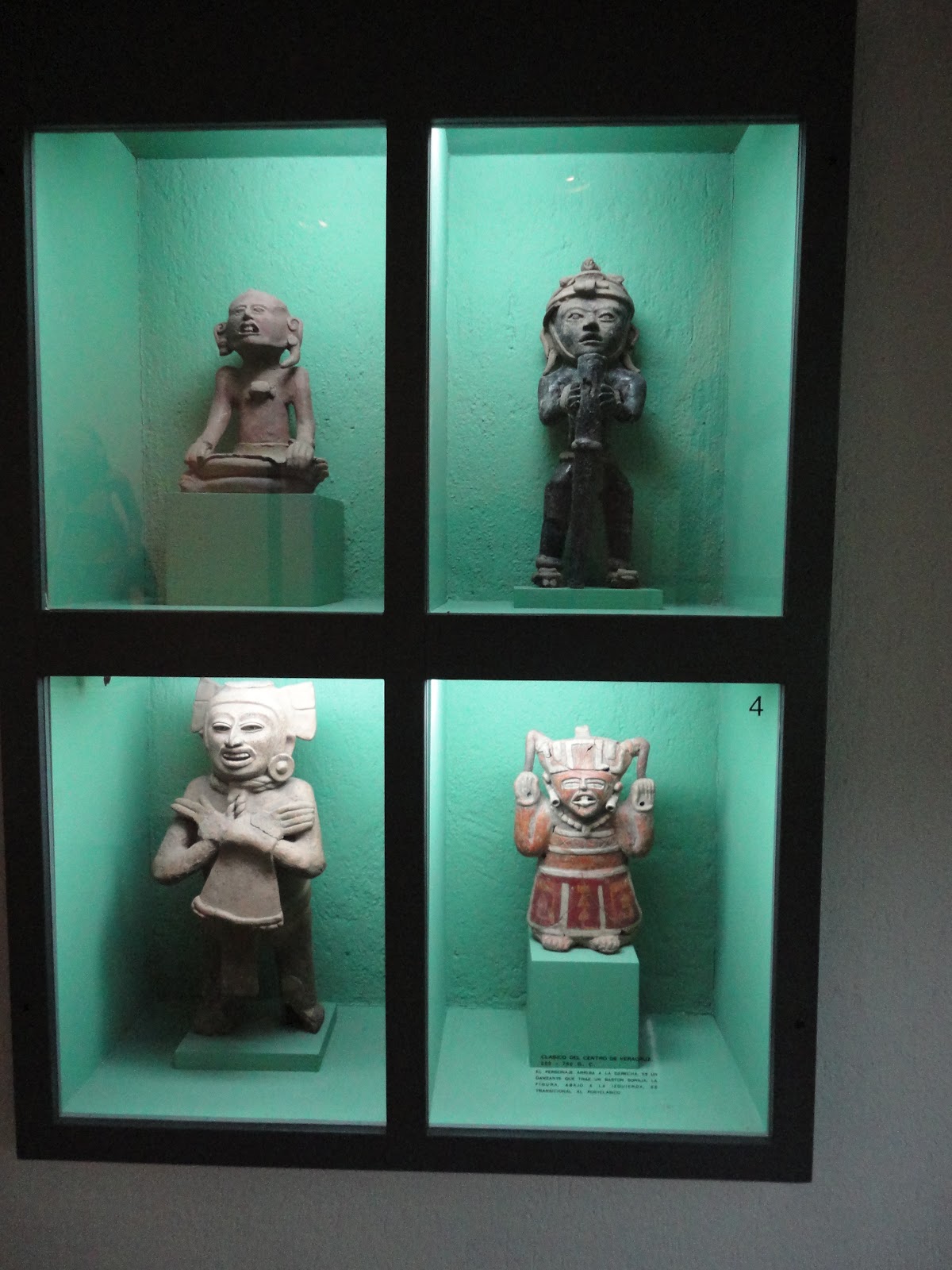
One of Mexico's most famous 20th century artists, Rufino Tamayo was a native of Oaxaca.  The Rufino Tamayo Museum houses not the paintings and lithographs and prints for which Tamayo became renowned, but instead showcases his personal collection of ancient artifacts of pre-Hispanic Mexico.  Before the time of the conquistadores, Mexico was not a land of just one culture, but was home to many different cultures, languages, and peoples.  Although the Aztecs are the best known, there were hundreds of other groups spread throughout what is modern-day Mexico, from the deserts in the northwest, through the central valleys, to the jungles and rain forests of the Yucatan and the south. 

Tamayo collected many artifacts before the days when archeological digs were carefully controlled .  and monitored.  The collection reflects Tamayo's interest in the artistic and aesthetic rather than the anthropological or archeological record.  Although many of the works have religious significance, for example, there is little commentary on that aspect, and more on the artistic development and influences within each region.  It is a fascinating museum, and was well worth the two or so hours I spent there.  Here are a few of the objects that particularly caught my eye:

This is a display case of ceramic dogs I liked:


Many of the figures are either depictions of the god(s) of death or funerary urns for use in the ceremony and rituals the pre-hispanic peoples.


These bas-reliefs were also quite exciting to see: 


The collection, which Tamayo donated to the city of his birth, is housed in a truly beautiful 17th century building.   Like many of the finer homes of that era, the rooms are arranged around a central courtyard, which is now a flower garden.


Thursday, May 3, 2012

The Zócalo in Oaxaca

Zócalo is an interesting word, because it refers to a particular architectural feature, namely a plinth or a pedestal, on which a great monument would be erected.  In Mexico, however, it refers very specifically to the Main city square, which is where the cathedral or main parish church is to be found, and also the principal government building. 


This is the facade of the Cathedral of Oaxaca.  Pictures of the inside will follow in a later post...
The zócalo is to be found to the right side as you face the cathedral. 
On two sides of the square there are restaurants, bars, ice cream shops, and a few high-end retail shops like a shoe store and clothing store.  The center of the square has shade trees, a fountain and a bandstand.  It was a great place to have breakfast one morning.  Wish I could remember the name of the place where I enjoyed huevos a la Oaxaqueña, which is scrambled eggs in salsa verde with Oaxacan string cheese, with a side of refried beans (black beans, not pinto beans) and fresh fruit. 
Early in the morning, it was quite refreshing to eat outside and to watch the vendors set up their goods. 

Above you can see the Government building in the background.
What looks like a calm and serene setting here in the morning becomes chaotic with crowds of people of every age in the evening.  Not only are there vendors of clothing, jewelry, embroidered tablecloths, ceramics, and basketry, there are musicians.  In one evening I heard including a mandolin and guitar group, a mariachi band, and an ensemble of xylophones.  Families gather in the zocalo, too, to enjoy the festive atmosphere.  Vendors were selling toys and balloons -- and some of the balloons were probably 12 feet long and children were laughing chasing them all over. 

Above you can see some of those enormous balloon that the vendors were selling and that children were chasing.  A clever idea for an simple, inexpensive, but entertaining toy. 

This is my favorite picture of a vendor on the zócalo:


Away and apart

"Oaxaca," writes Kathryn S. Blair, "is a land unto itself..."  She goes on to describe "a southern State spread high in the mountains, extending in the west to the Pacific Ocean and in the east to the State of Verzcruz on the Gulf of Mexico."  These words come from her book entitled  Forging a Nation, which is a history of the Mexico from the time of the Aztecs to the present.*  Over the past days, I had the chance to visit this historical, beautiful, and captivating city.  Tuesday was a national holiday in Mexico, the Day of the Worker -- something like the US holiday of Labor Day (more about this in a later post) -- so I decided to take a 'long weekend' and leave Mexico City after Church on Sunday and stay through Monday and Tuesday to get away away and see another part of the country. 


This flag flies from the Government Palace, which is on the Zocalo, the main square in the center of the city, which is the heart and soul of Oaxaca. 


The two pictures above are of one of the streets in the historic district (colonial center) of the town.  Most fascinating of all is the appearnace of the streetscape, many elements of which seem to have changed little from the colonail era.  You can see from the photos the quintessential design elements of the Spanish colonial period -- large windows, thick walls, balconies. and wrought iron balustrades.  All along this street (and there were literally HUNDREDS of people on this street on a weeknight) -- there were vendors of food, handmade clothing, rugs, baskets, blankets and jewelry.  In some ways, Oaxaca is a city frozen in time,  Yet in other ways, it is utterly contemporary.  On the last night I was there, one of the streets was blocked off so that a series of documentary films (one on the subject of  astrophysics!)  could be shown outside at a huge makeshift theatre that had been created by erecting a huge screen and putting several hundred folding chairs in front of it. 

Oaxaca is, indeed, a land unto itself.  Contemporary and ancient, modern and classical, sophisticated and simple, predictably conservative and wildly avant garde.  I'll probably take a few days to blog about all that I saw and experienced in Oaxaca (I took over 200 pictures in only two full days -- so there's a lot to show.)

*Kathryn S.  Blair is a member of Christ Church in Mexico City.  Her book is published by San Miguel Historical Press of Mexico City.  I don't know if it is also available available in the US, but it is well worth seeking out.  While the multi-faceted story of Mexico is fascinating in its own right, Ms. Blair's prose is accessible, engaging, and even entertaining.  I recommend it highly.